
California's Native Fish Crisis
 CalTrout issues a detailed status report of California native fish. Warning: Large PDF File.
Paiute Cutthroat
Native to the Silver King Creek drainage in the Carson-Iceberg Wilderness of California, the Paiute cutthroat trout has the smallest historic range of any trout in North America. Roughly eight to ten thousand years ago, Paiutes were isolated from their Lahontan cutthroat relatives in the Carson River basin.
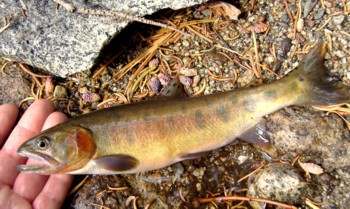
Photo of rare Paiute cutthroat contributed by Eric Herve.
The separation resulted after a number of insurmontable water falls formed within the Silver King Creek. Sheep herders introduced Paiutes to the water above Llewellyn Falls, in 1912. And today, thanks to the natural barriers that exist, a robust population of Paiute cutthroat trout exists above these falls and three tributaries - Fly Valley, Four Mile Canyon, and Bull Creeks. Paiute cutthroat also inhabit two tributaries below the falls - Coyote Valley Creek and Corral Valley Creeks.
From a 1987 Trout Magazine article written by Robert Behnke: "The Paiute cutthroat was dicovered and named in 1933 when J.O. Snyder of Stanford University received some specimens fo trout collected in Silver King Creek above Llewellyn Falls (named after Mrs. Lynn Llewellyn, who caught the specimens). Snyder realized that Silver King Creek is a tributary of the East Carson River of the Lahontan Desert Basin. He knew the trout found above the waterfall represented an isolated population derived from Lahontan cutthroat trout (Salmo clarki henshawi), but he was so impressed by their distinctive characteristic--the absense of spots on the body--that he originall described them as a new species, Salmo seleniris. The name seleniris for the new trout was selected because it suggested a 'fanciful resemblance of its evanescent tints to the lunar rainbow.'"
Identifying Paiute Cutthroat
Paiute cutthroat trout are distinguished by their almost complete lack of body spotting and iridescent purplish hue body coloration. It is the only western trout that consistently has no obvious spots on the body. Paiute trout have no body spots, but do have parr marks, which are occasionally seen even on adult fish. Parr marks are oval or oblong markings along the side of the body of most trout.

